-
sdr.sinusoid(duration: float, freq: float =
0.0, freq_rate: float =0.0, phase: float =0.0, sample_rate: float =1.0, complex: bool =True) NDArray Generates a complex exponential or real sinusoid.
- Parameters:
- duration: float
The duration of the signal in seconds (or samples if
sample_rate=1).- freq: float =
0.0¶ The frequency \(f\) of the sinusoid in Hz (or 1/samples if
sample_rate=1). The frequency must satisfy \(-f_s/2 \le f \le f_s/2\).- freq_rate: float =
0.0¶ The frequency rate \(\frac{df}{dt}\) of the sinusoid in Hz/s (or 1/samples\(^2\) if
sample_rate=1).- phase: float =
0.0¶ The phase \(\phi\) of the sinusoid in degrees.
- sample_rate: float =
1.0¶ The sample rate \(f_s\) of the signal.
- complex: bool =
True¶ Indicates whether to generate a complex exponential or real sinusoid.
True: \(\exp(j\theta(t))\)False: \(\cos(\theta(t))\)
- Returns:
The sinusoid \(x[n]\).
Notes
The instantaneous frequency is
\[ f(t) = f + \frac{df}{dt} t \]The phase is the time integral of the instantaneous frequency plus the initial phase.
\[ \theta(t) = 2 \pi \int_0^t f(\tau)\,d\tau + \phi = 2 \pi \left(f t + \frac{1}{2}\frac{df}{dt}t^2\right) + \phi \]Examples
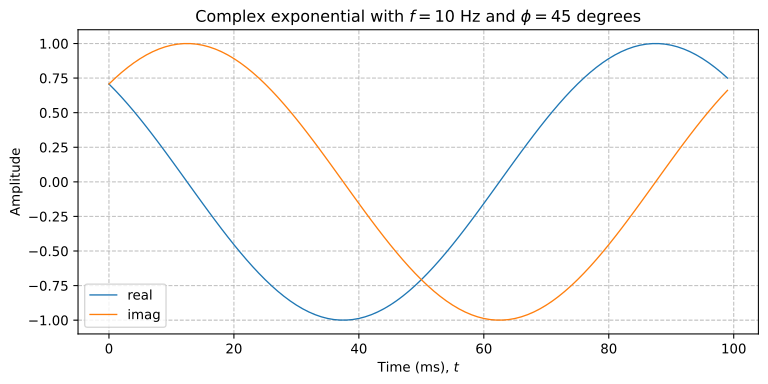
Create a complex exponential with a frequency of 10 Hz and phase of 45 degrees.
In [1]: sample_rate = 1e3; \
   ...: N = 100; \
   ...: lo = sdr.sinusoid(N / sample_rate, freq=10, phase=45, sample_rate=sample_rate)
   ...:

In [2]: plt.figure(); \
   ...: sdr.plot.time_domain(lo, sample_rate=sample_rate); \
   ...: plt.title(r"Complex exponential with $f=10$ Hz and $\phi=45$ degrees");
   ...:
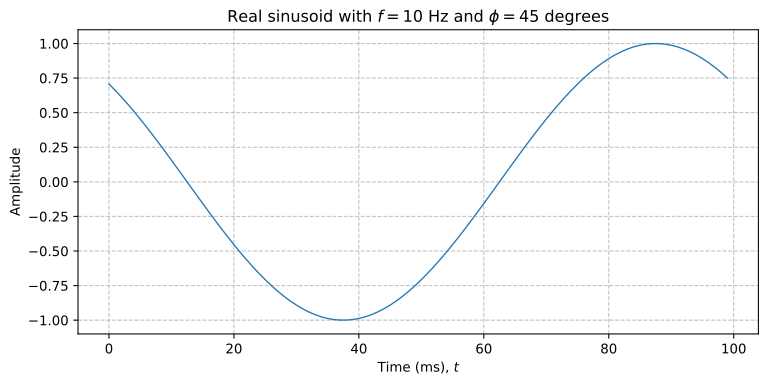
Create a real sinusoid with a frequency of 10 Hz and phase of 45 degrees.
In [3]: lo = sdr.sinusoid(N / sample_rate, freq=10, phase=45, sample_rate=sample_rate, complex=False)

In [4]: plt.figure(); \
   ...: sdr.plot.time_domain(lo, sample_rate=sample_rate); \
   ...: plt.title(r"Real sinusoid with $f=10$ Hz and $\phi=45$ degrees");
   ...: